A key concept while thinking about the principles of design is value. Put simply, value is the emphasis on the lightness versus the darkness of color in a design or work of art. Below is a value scale depicting a basic concept of value. Value allows artists to create contrast or place emphasis on specific areas of their design just by making one area darker or lighter than another.
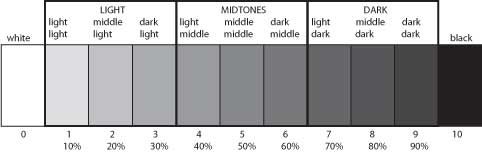
The concept of value can be further split up when other ideas, such as distribution, volume, space, and lighting come into play. Perfected in the Renaissance, the term chiaroscuro (Italian for light and dark) allows value to create dimension when the contrast and drama between the light and dark is heightened.
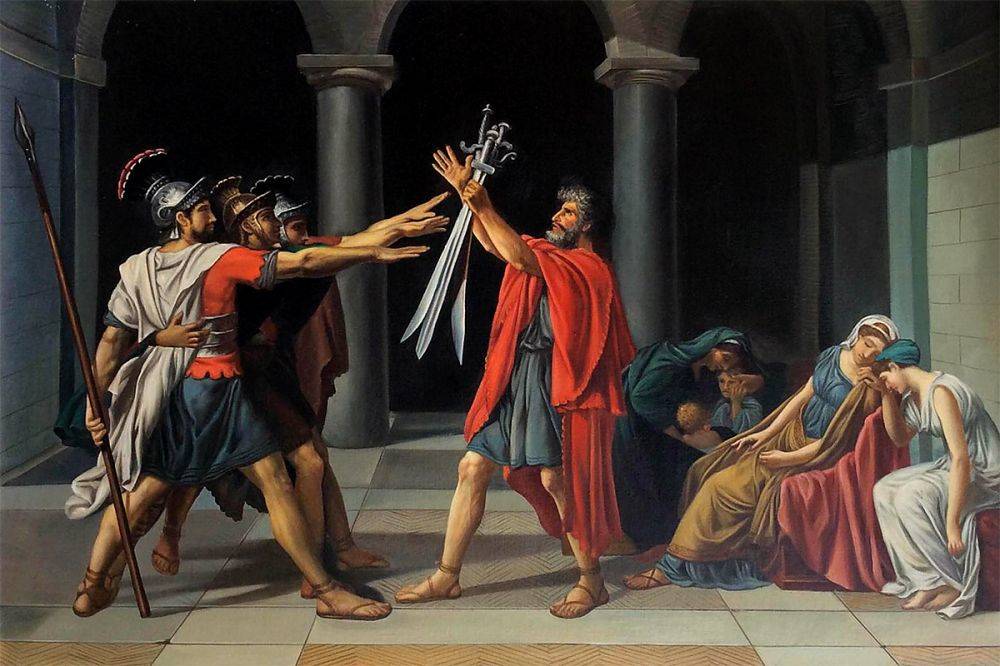
Another key concept when highlighting the principles of design is the use of unity and variety. Going hand in hand, unity essentially creates a wholeness from the successful combination of elements in an artwork. Unity can be conceptual (based on a variety of ideas) or visual (based on the elements of art), while variety is used to combine elements to create relationships to offset unity and add interest. Below, Jacque-Louis David’s Oath of the Horatii can be used to describe the relationship between unity and variety. The sons are united to their father, family, and patriotism through their movement towards the swords in the center, while variety is represented by the mourning women off to the right. This piece not only can be used to represent unity and variety, but repetition as well. Repetition is the use of multiple of the same element to create emphasis. The repeating hands and swords draw the viewer to the center of the image and what the gesture symbolizes.
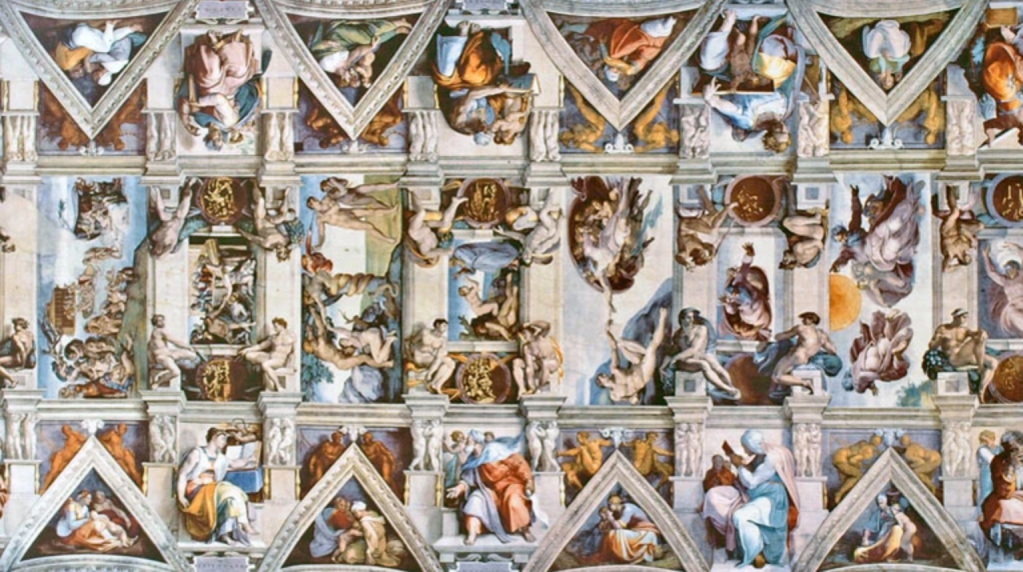
Another principle of design is an emphasis on patterns and grids. This is the use of a visual element’s repetition to create a system of design. This goes hand in hand with closure, which is the brain’s creation of a complete form. These principles can be represented in Michelangelo’s fresco paintings in the Sistine Chapel, as a pattern of multiple scenes in combination with the closure of the elements of the ceiling’s built-in supports creates a decoration with complex forms and backgrounds. Furthermore, the concept of rhythm (combination of elements repeated, with variations, to create a sense of movement) can also be applied here.
Many other concepts can be analyzed when considering principles of design and elements of art. Symmetry, or the sameness of one side to another (or approximate symmetry, which is used when one side is close enough to the other) allows for designs to be concise and straightforward. This leads into the idea of balance, or the arrangement of elements to create a feeling of stability.
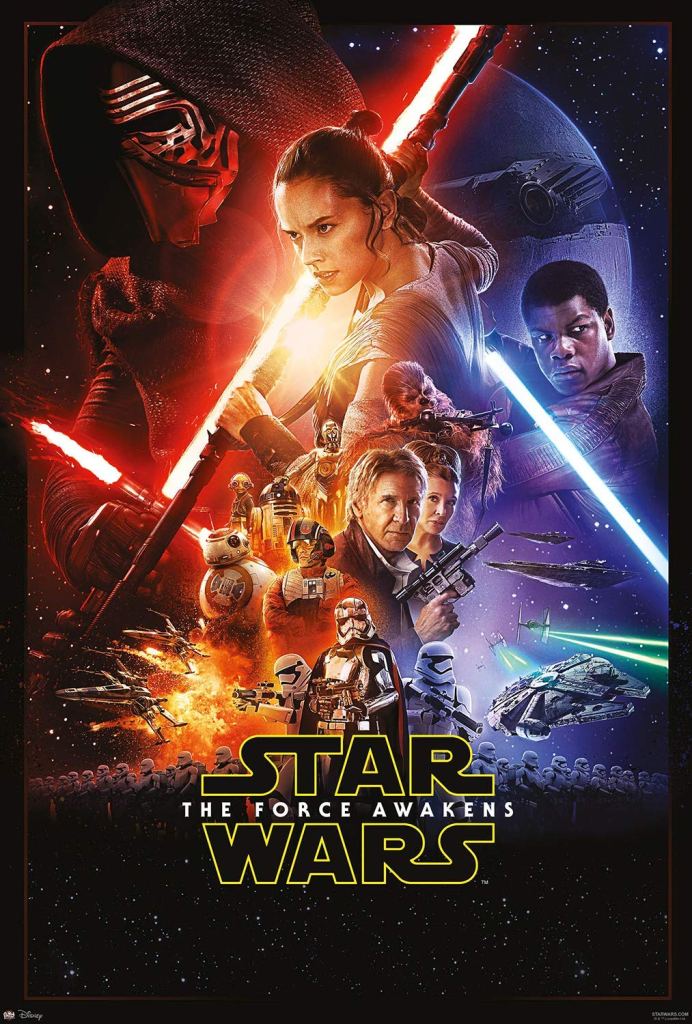
Further, the ideas of scale (size of an object in relation to its standard or expected size) and proportion (size relationship of an object’s parts to the whole) can be applied to emphasize certain aspects of a design. A common example of this is the Hieratic scale, where significant figures are depicted the largest. This originally is shown in Egyptian art, but was made popular in several movie posters. The Star Wars movies used this in almost every movie poster they put out. Below is the movie poster for The Force Awakens, where all of the most important characters are shown the largest.
Most, if not all, of these principles and elements are used in order to create emphasis on a subject. Whether it’s a famous Monet or a middle-school art class project, any one of these can be used by itself or in conjunction with others in order to draw the viewer towards a specific area of the work in order to understand the piece’s subject.

 Peder Harvey Design